

Frustrated with “undertones”?
You’re not alone.
Here's what no one tells you about undertones - they aren't facts. Everyone struggles understanding what undertones are and how to see them.
The problem is that color appearance constantly shifts depending on lighting, surroundings, and context.
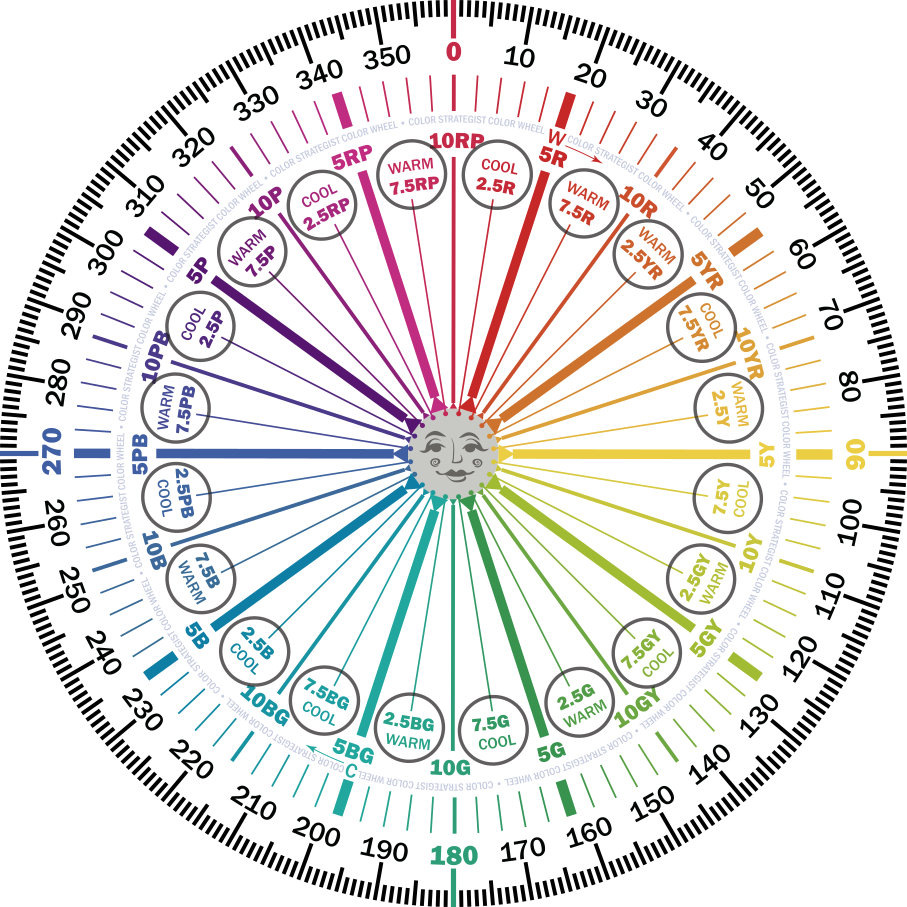
The Color Strategist Color Wheel© organizes colors using measurable Hue Family notation instead of relying entirely on subjective visual interpretation.
Relief from frustrating visual gymnastics starts here.
A Color’s Hue Family Is Like Its DNA
Hue Family notation can be traced back to measurable color data values — like a color’s DNA.
Once colors are organized objectively, the wheel literally draws a picture of what colors go together.
- Hue relationships
- Overtone influence
- Warm and cool designation
- Neighboring Hue Families
Understanding the Wheel
What Does “h” Mean?
The lowercase “h” represents hue angle in the CIE LCh color space.
The degrees on the outside of the wheel correspond to the “h” (hue angle) value shown in your app’s LCh color format.

The 10 Hue Families
The inside spokes represent the ten Hue Families used in the Munsell Color System:
Each Hue Family is divided into 10 smaller units.
Example: 1Y, 2Y, 3Y through 10Y.
The large dots mark the “5” position where the parent hue is perceived most strongly.
What Is Overtone?
Colors often carry a visible bias toward a neighboring Hue Family.
For example, a yellow may lean slightly toward orange or slightly toward green.
The wheel helps visualize those relationships clearly.
Why the “5” Positions Matter
The number 5 in each Hue Family marks the point where the highest concentration of the parent hue is perceived.
For example, 5Y sits at 90° on the wheel.
As you move counterclockwise from 5Y toward Yellow-Red, the amount of perceivable yellowness lessens while yellow-red (orangeness) increases.
The Hue Family notation helps describe both the dominant hue and neighboring hue influence visible in the color.

A Color Wheel Includes Neutrals Too
Whites, grays, greiges, taupes, creams, and blacks all belong to Hue Families.
A color wheel is not limited to saturated colors.
The wheel you see is one slice through a larger 3-dimensional color space where all colors exist across hue, value, and chroma.
Warm and Cool Designations
While perceptual color temperature isn't a measurable color attribute, there are predictable patterns behind why colors feel warmer or cooler.
Hue Family relationships influence how warmth and coolness are perceived. As colors move around the wheel, neighboring hue influence and overtone shift how a color feels visually.
The Color Strategist Color Wheel© helps visualize those directional relationships more clearly using measurable Hue Family notation instead of relying entirely on subjective interpretation.
To learn more, read: Disrupting What You Think You Know About Warm and Cool Colors
Color Harmony
Use the Color Strategist Color Wheel© to visualize classic color relationships including:
- Analogous
- Complementary
- Split Complementary
- Triadic
- Tetradic
- Monochromatic
The wheel helps simplify how colors coordinate across interiors, exteriors, and fixed finishes in the built environment.
88 Harmonious Hue Family Relationships
The Color Strategist Color Wheel© includes mapped harmony pathways based on classic color relationships.
These harmony relationships help simplify color coordination in a more measurable and structured way.

